




EISS Strategic Assessment No. 02/2026 | November 2026
Institutional analysis | Research cutoff: 28 November 2026
Executive summary
Ethiopia’s national security challenges increasingly arise from the interaction between domestic political fragmentation, armed conflict, humanitarian distress and deteriorating regional relations. The renewed fighting in northern Ethiopia during 2026 demonstrates the limitations of treating military security independently of political settlements and institutional legitimacy. This assessment examines the foundations of national resilience through a framework encompassing constitutional governance, civilian protection, economic continuity and regional diplomacy.
The central analytical proposition is that territorial integrity and effective public institutions are mutually dependent. Military control alone does not establish durable stability, while political agreements without credible implementation mechanisms may fail to prevent renewed violence. An assessment of national security must consequently consider both immediate threats and the capacity of institutions to manage disputes peacefully.
1. National security as an institutional system
National security architecture comprises the institutions, legal frameworks and relationships through which a state protects its population, territorial integrity and constitutional order. It includes defence institutions, civilian administration, courts, regional governments, emergency services and diplomatic mechanisms. Its effectiveness depends not merely on the resources available to these institutions but also on their coordination, accountability and ability to maintain public confidence.
In a federal state, security responsibilities intersect with regional autonomy and local political legitimacy. Disagreements over jurisdiction can become particularly consequential when competing political organisations maintain armed forces or when communities perceive state institutions as inaccessible. The analytical challenge is to distinguish demands that can be addressed through constitutional negotiation from acts of violence requiring lawful security responses. Neither regional identity nor political opposition is inherently a security threat.
A resilience-based framework evaluates whether institutions can absorb shocks without abandoning essential functions. Indicators include continuity of public services, access to justice, predictable intergovernmental transfers and mechanisms for resolving disputes without armed confrontation.
2. Northern Ethiopia and the Pretoria framework
The November 2022 cessation of hostilities agreement between the federal government and the Tigray People’s Liberation Front established a framework for ending the northern war. Its provisions covered disarmament, political dialogue and restoration of constitutional administration. The US Congressional Research Service’s November assessment identifies unresolved implementation questions, including the withdrawal of other armed forces and the reintegration of former combatants [1].
The return of armed confrontation in 2026 reveals the distinction between ending hostilities and establishing a sustainable political settlement. Outstanding territorial disputes, competing claims to regional authority and incomplete reintegration cannot be resolved simply by declaring that an agreement remains in force. Effective implementation requires a shared understanding of obligations and credible verification.
On 8 October, the African Commission on Human and Peoples’ Rights published a statement urging renewed adherence to the Pretoria commitments, civilian protection and negotiated resolution [2]. Its intervention underscores the importance of the African regional human rights system alongside diplomatic mediation.
Future assessments of the peace framework should examine whether displaced residents can return voluntarily and safely, whether political participation is possible without intimidation, and whether disputes concerning implementation can be referred to credible institutions. These are substantive measures of progress, rather than substitutes for negotiations over the underlying political disagreements.
3. Amhara, Oromia and the changing configuration of armed opposition
The security landscape extends beyond Tigray. Armed confrontation in Amhara and Oromia reflects distinct regional histories, grievances and relationships with federal authorities. Treating all conflicts as a single movement would obscure the differences between their participants and the communities affected by them.
A UK House of Commons Library briefing published on 24 November describes the formation of an alliance involving the TPLF, an Amhara Fano organisation, the Oromo Liberation Army and other groups. It also documents insecurity in southern Ethiopia and disputed accounts of violence against religious communities [3]. Sources differ in their enumeration of alliance members; this assessment therefore avoids treating a precise membership count as settled.
Coordination among previously opposed organisations may change the political environment, but an announced coalition does not demonstrate unified command, a common constitutional programme or consistent support across the communities its members claim to represent. Its significance must be evaluated through verified political developments rather than assumptions of cohesion.
Conflict analysis requires separating the conduct of armed actors from the identity of wider ethnic and religious populations. Collective attribution risks reinforcing divisions and weakening opportunities for mediation. Independent investigation of abuses and access to remedies are essential components of an evidence-based security assessment.
4. Civilian protection and continuity of essential services
Humanitarian conditions are not merely consequences of insecurity; they can also affect the capacity of institutions to recover from conflict. Displacement disrupts employment, education and local administration. Interruptions to healthcare and agricultural livelihoods may continue long after violence subsides.
The UK Home Office’s humanitarian bulletin, updated on 17 November, documents the uneven availability of essential services in Tigray and the cumulative effects of displacement, renewed hostilities and climatic pressures [4]. On 2 November, Associated Press reported warnings from the World Health Organization’s director-general concerning civilian harm and shortages of medical personnel and supplies in northern Ethiopia [5].
A further Associated Press report on 25 November described Amnesty International’s call for independent investigation of alleged unlawful attacks in Tigray, alongside allegations concerning the conduct of Tigrayan forces that the TPLF disputed [6]. Such allegations require impartial examination; they should not be presented as judicial findings.
Possible resilience indicators include the functionality of health facilities, school attendance, continuity of water supplies and the ability of humanitarian organisations to reach affected populations. Reporting should distinguish verified conditions from estimates and identify geographical gaps in available evidence.
5. Federal governance and institutional legitimacy
Federal governance presents both opportunities and challenges for national cohesion. Regional institutions can adapt administration to local circumstances and provide meaningful representation. Conversely, disputes over administrative boundaries, political participation and resource allocation can become destabilising when credible mechanisms for adjudication are absent.
Institutional legitimacy is not synonymous with unanimous political agreement. It concerns whether public authorities exercise their powers within predictable rules, whether citizens can challenge decisions peacefully and whether administrative services remain accessible regardless of political affiliation. Security measures that lack transparent legal oversight may impose costs on public confidence even when justified as emergency responses.
Comparative research could examine the effectiveness of intergovernmental dispute-resolution bodies, parliamentary scrutiny, independent courts and local mediation institutions. Such inquiry should consider the perspectives of federal authorities, regional administrations, civil society and conflict-affected residents without presuming that any one constituency speaks for an entire region.
6. Economic security and the fiscal consequences of conflict
Prolonged insecurity creates opportunity costs for development. Public resources allocated to emergency response cannot simultaneously finance the same level of infrastructure investment or social services. Disrupted transport, uncertainty over property rights and reduced household purchasing power may also affect private investment and economic activity.
These effects should be measured rather than assumed. An economic security assessment could track regional market access, trade continuity, inflation in conflict-affected areas, public revenue collection and expenditure on reconstruction. National averages may conceal substantial regional variation.
Reintegration programmes for former combatants illustrate the relationship between economic and security policy. Their sustainability depends on funding, access to livelihoods and the participation of receiving communities. Programmes must also consider civilians who experienced displacement or loss of assets, to avoid creating perceptions of unequal access to recovery assistance.
7. Regional spillover and diplomatic resilience
Ethiopia’s internal security cannot be separated entirely from the surrounding region. The United Nations Secretary-General’s statement of 9 October expressed concern about renewed northern hostilities and reports of Eritrean forces inside Ethiopia, while emphasising non-interference, territorial integrity and de-escalation [7]. The war in Sudan creates additional humanitarian and diplomatic pressures.
Cross-border allegations require careful treatment. Claims of external support for armed organisations should be distinguished from independently corroborated evidence. Public attribution without sufficient verification can complicate diplomatic engagement, while credible monitoring can help clarify contested incidents.
Regional diplomatic resilience can be assessed through the continuity of bilateral contacts, cooperation on humanitarian movements and the availability of mediation channels. The African Union and United Nations offer institutional frameworks for addressing disputes, although their effectiveness depends on the cooperation of relevant parties.
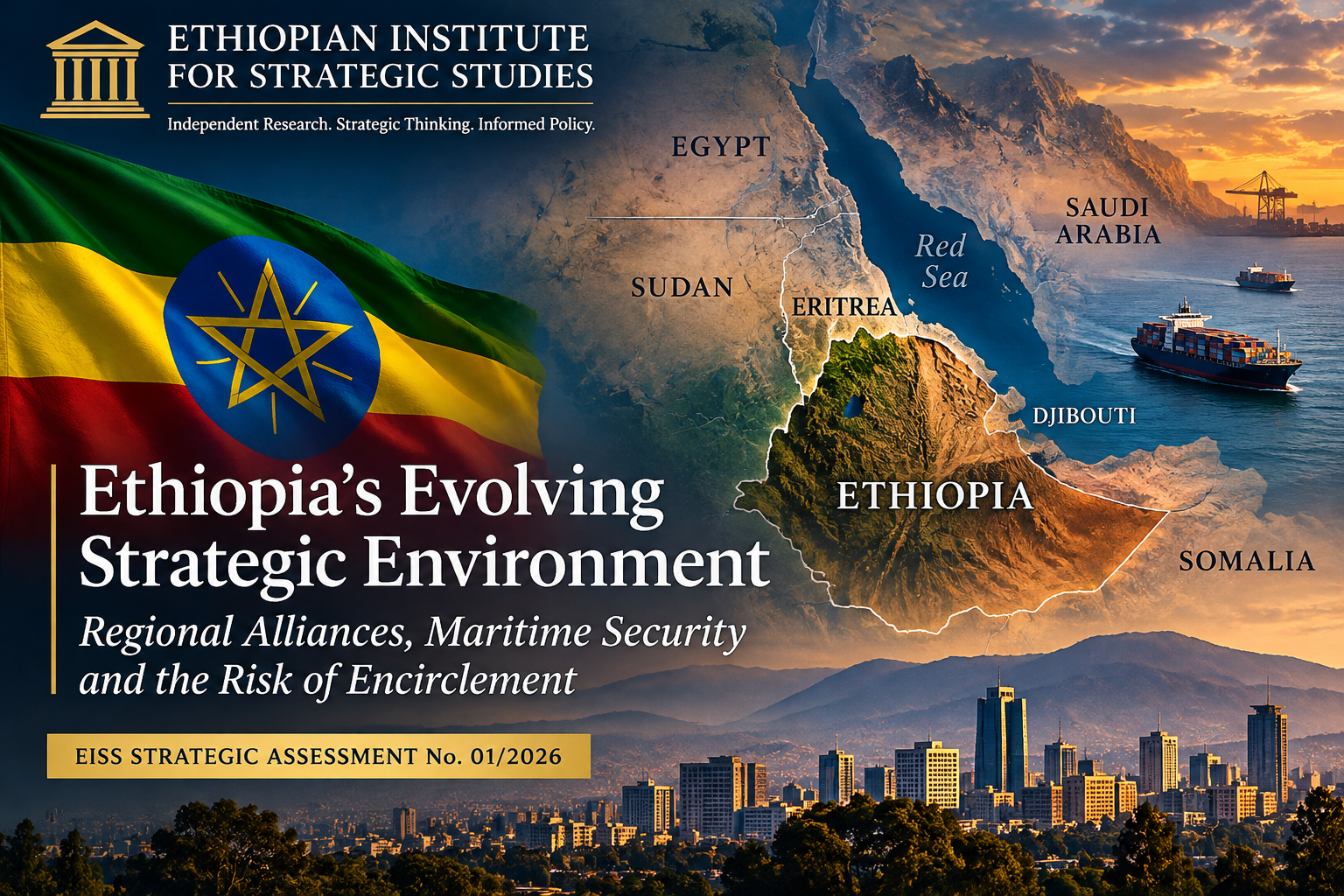
This dimension complements EISS Strategic Assessment No. 01/2026, which examined maritime access and external geopolitical alignments.
8. Strategic scenarios for 2027
The following scenarios are conditional analytical frameworks, not forecasts or probability rankings.
Scenario A: Negotiated institutional recovery
Renewed political dialogue creates opportunities for verified ceasefire arrangements, restoration of services and resolution of implementation disputes. Recovery remains uneven, and progress depends on sustained participation, funding and credible oversight.
Scenario B: Persistent fragmented insecurity
Localised conflicts and unresolved political disputes continue without a comprehensive settlement. Public institutions retain essential functions in some areas while facing recurring interruptions elsewhere. Development priorities compete with emergency expenditure, and humanitarian needs remain substantial.
Scenario C: Regional escalation
Domestic violence becomes increasingly intertwined with interstate disputes. Diplomatic relationships deteriorate and humanitarian pressures extend across borders. The capacity of national and regional institutions to maintain essential services comes under greater strain.
Assessment of these scenarios should focus on independently verified changes in political dialogue, civilian safety, public service delivery, displacement and diplomatic engagement. No single indicator establishes that a scenario is unfolding.
9. Policy options and evaluation framework
The following areas warrant comparative policy research. They are not representations of official government policy.
- Peace agreement implementation: examine independent verification, dispute-resolution procedures and funding requirements for outstanding commitments.
- Constitutional dialogue: compare mechanisms for addressing federal-regional disagreements while protecting lawful political participation.
- Civilian protection: evaluate independent investigation, humanitarian access and accountability mechanisms applicable to all parties.
- Economic recovery: assess reconstruction priorities, continuity of essential services and equitable access to livelihood assistance.
- Regional diplomacy: examine mediation, crisis communication and verification arrangements in cooperation with relevant African and international institutions.
- Research capacity: develop transparent indicators, disclose uncertainty and distinguish official statements from corroborated findings.
These options carry different costs and implementation constraints. Monitoring requires access and consent; reconstruction requires financing and administrative capacity; political dialogue requires credible participation. Evaluation should make these dependencies explicit and include the experiences of affected communities.
Conclusion
Ethiopia’s national security architecture faces interconnected political, humanitarian, institutional and regional pressures. A comprehensive assessment of resilience must extend beyond immediate military outcomes to the durability of public institutions, the protection of civilians and the ability to resolve disputes without violence. The future of the Pretoria framework, regional governance and economic recovery will provide important evidence for evaluating these conditions during 2027.
The central research question is how Ethiopia can preserve constitutional order and territorial integrity while ensuring that security institutions remain accountable and responsive to the diverse population they serve. This question deserves sustained empirical inquiry rather than partisan conclusions.
References and methodology
This desk-based assessment uses public sources available by 28 November 2026. It has not undergone independent academic peer review and does not rely on original fieldwork or classified intelligence.
- Congressional Research Service, 6 November 2026. The Unfolding Conflict in Ethiopia.
- African Commission on Human and Peoples’ Rights, 8 October 2026. Statement on the renewed tensions in northern Ethiopia.
- Louisa Brooke-Holland, House of Commons Library, 24 November 2026. Conflicts in Ethiopia and Sudan highlights risks of wider regional instability.
- UK Home Office, updated 17 November 2026. Country bulletin: humanitarian situation in Tigray.
- Associated Press, 2 November 2026. Ethiopia attacks kill civilians as health system nears collapse, WHO chief says.
- Associated Press, 25 November 2026. Amnesty calls for independent war crimes probe into Ethiopian shelling in Tigray.
- United Nations, 9 October 2026. Secretary-General’s statement on Ethiopia, published on the UN Ethiopia website on 10 October.
Published under the EISS strategic assessment series. This analysis does not represent an official governmental position.